

The Deeper Meaning of the Precepts
by Rev. Master Jiyu-Kennett
(The following selection is an excerpt from The Wild, White Goose, by Rev. Master Jiyu-Kennett, p.101-106. This book is edited selections from Rev. Master Jiyu-Kennett’s diaries of her first years of training as a Buddhist monk, mostly in Japan. This section was written after she has been training at Sojiji, a large Soto Zen monastery in Japan, for about seven months. Rev. Hajime, an English-speaking senior monk, had been assigned to help teach her. )
Rev. Hajime came back this morning, instead of last night as he had originally arranged, but it did not really make very much difference because as soon as he had eaten, he called me into his room and said, “I think it’s about time we started translating the Precepts.”
I said, “But I already know them.”
“Yes, you know the version that most people are given but you do not yet know the Kyojukaimon.”
“I heard it during my Jukai ceremony.”
“Did you understand it fully?”
“No, the Japanese was too old for me to be able to.”
“That’s what I meant, so we’re going to translate it. Get some paper and we’ll get on with it at once.”
I settled down at a side desk, which he has now arranged for me in his room, and he got out the old book and started working on it. We had just finished the beginning preamble and had got to the first Precept, “Do not kill, but no life can be cut off. Do not kill Buddha. Do not cut off the life of Buddha,” when he said,
“Before we go any further, I want you to explain that.” “Oh. ‘Do not kill.’ I understand that.”
“But do you understand ‘not cutting off the life of Buddha,’ because only that is real death?”
“I think so. May I tell you what I think it is?” “Of course. I am waiting.”
“As I understand it, it’s a matter of mind attitude in the sense of the kokoro, the heart-mind, wanting to do harm. One frequently accidentally kills. We kill millions of microbes every hour of the day just by breathing and we’re always treading on grass and insects and things like that. To ‘cut off the life of Buddha’ is to will to hurt, to harm; to will to kill, if you like, the compassion within ourselves; to will to kill the feeling that other creatures have the right to live.”
“Go on.”
“Let me think. How can I put this? The trouble is I know what I’m trying to say and I can’t get it out.”
“I know that one but what are you going to do when you have to lecture to people who come to you with questions like this? You have to be able to talk to them on these matters; you have to be able to explain them.”
“Yes, let me think again. I know what it means. It’s the ‘with’ we were talking about yesterday.”
He smiled. “Take it from there.”
“If we kill something deliberately there’s a bit of ourselves that we’re cutting off and there’s something even more than that. We’re saying that something hasn’t got the right to live; in other words, that something hasn’t got the right to be Buddha. There’s something that we’re not accepting . . . . . there’s something we’re saying . . . . . just . . . . . well, can’t be Buddha. That’s the Precept that everybody breaks when they say, ‘Oh, well, this is pure and that’s impure.’ When they say that a . . . . . purity is . . . . . It means that if I say that Hitler is difficult to see as a Buddha I am trying to kill Buddha; if I say some- thing is unclean I am killing the Buddha Nature within that thing itself; if I say . . . . . but that means that morality has to be thought of from a totally different angle, for morality is only a rule of thumb: that which leads to a higher, truer morality—a morality beyond morality. At a later date, as we spiral in, we discover that we cannot really live completely by the Ten Precepts, otherwise we are always working out which one to break and which one not to. We have to live by the Three Pure Precepts, but even they are not enough. Every time we look at somebody and say, ‘Well, I can see the Buddha Nature in so-and-so but I can’t see it in him over there,’ we’re literally killing the Buddha and it’s our own delusions that kill the Buddha. That’s why we don’t know that we ourselves are Buddha. That is why we are not enlightened. Because we cannot recognize the Buddha in all things, we constantly kill the Buddha. We can know, we can feel instinctively, that the Buddha is everywhere but we have not under- stood the ‘with,’ we have not understood that our bones, flesh, blood, marrow . . . . . yes, and our sexual side as well, and all the mud and the things we hate and all the torture side of ourselves and all the evil, all is the aspect of the Buddha Mind. We have to learn to accept it and work through it and bring compassion to bear on those who only exhibit one aspect, and even love them whilst we restrain them because, only by so doing, can we teach them better things. So, every one of us is a murderer every day of the week; every time we discriminate against someone else.”
“Quite correct.”
“That is the meaning of ‘do not kill.’ It is not just ‘don’t go out and slaughter an animal for food,’ it is ‘don’t discriminate against other people, don’t set yourself up, don’t say “I know who’s a true teacher and I know who isn’t,” because, instantly, we are killing. All the Precepts interact upon each other and spiral in. After a bit we get over the fact that the Ten Precepts are the limit of morality and go on to something deeper. We come to where the Ten Precepts fall away and all we have to live by are the Three; to cease from evil, to do only good and to do good for others.”
“That’s right.”
“Then they fall away too, because they’re still bounded, and we are left with the True Heart within us which is the Buddha Nature. That’s why ‘Homage to the Buddha, Homage to the Dharma, Homage to the Sangha’ are the only Real Precepts and anybody who takes the refuges completely has taken the Precepts. It means that I believe there is within me something greater, something far more wonderful than I have yet been able to show to the world. It means that I know that within me is something intrinsically good and that I can be worthy of it by being better than I am; that there is a teaching which can help me and that there are priests who have realized their True Nature who can give me guidance.”
“Good. Now you have understood ‘do not kill.’ You have understood that no life can be cut off and you have understood it from the moral, from the Lord of the House and from the ‘with.’ You have gone through the phases and now your training must express it. At a later date you will take it deeper still.”
“I’ll try. I honestly will.”
“I believe it but you will fall many, many times and every time you fall you’ve got to scramble back; and you’ve got to go on believing that you can scramble back.”
“That’s the meaning of faith. Faith isn’t a belief in an outside God; it isn’t a belief in something external. It’s the belief that one can always go on and do better than one has done before through
the guidance of the Buddha Nature. That’s the real meaning of belief.”
“Yes, so it is.”
“Faith is the faith in us. It’s the faith in the Buddha Nature; in our possession of it. Now to really try and put it into practice.”
“We will go through the other Precepts steadily over a period of time and you will find that they are all one and the same Precept.”
“Can’t we do them now? ‘Do not steal, but there is nothing to be stolen.’”
“Tomorrow. Don’t try to rush. The world takes time to develop and so can you. You’ve already got a long way. I want you to settle down and work quietly; let these things sink in. Remember that just having a kensho is not nearly enough; all that it does is open up the panorama; whether or not we want to see it is an- other matter.”
“Yes. Seeing God is one thing and knowing how to live with Him is quite a different one or, better still, becoming a saint is quite a different one. That is the meaning of endless training.”
“Correct. What you have to do, now you have seen it, is learn to understand and express it.”
“But don’t you realize that you’re— well, —sort of not teaching me anything, you’re dragging it all out of me?”
“That is how Zen is taught. The master only points the way. Re- member what it says in the Scriptures, ‘Trainees contain the ultimate, masters contain the means; correctly blended this is good.’ All Zenji Sama and I do is point. You have done the work and you walk alone and you can walk alone very well indeed. Why do you want any more?”
“It’s just a totally different concept of teaching, that’s all. Always, when I was being taught before, the teachers were putting stuff in, never taking it out.”
“That’s the meaning of faith. Faith isn’t a belief in an outside God; it isn’t a belief in something external. It’s the belief that one can always go on and do better than one has done before through
the guidance of the Buddha Nature. That’s the real meaning of belief.”
“Yes, so it is.”
“Faith is the faith in us. It’s the faith in the Buddha Nature; in our possession of it. Now to really try and put it into practice.”
“We will go through the other Precepts steadily over a period of time and you will find that they are all one and the same Precept.”
“Can’t we do them now? ‘Do not steal, but there is nothing to be stolen.’”
“Tomorrow. Don’t try to rush. The world takes time to develop and so can you. You’ve already got a long way. I want you to settle down and work quietly; let these things sink in. Remember that just having a kensho is not nearly enough; all that it does is open up the panorama; whether or not we want to see it is an- other matter.”
“Yes. Seeing God is one thing and knowing how to live with Him is quite a different one or, better still, becoming a saint is quite a different one. That is the meaning of endless training.”
“Correct. What you have to do, now you have seen it, is learn to understand and express it.”
“But don’t you realize that you’re— well, —sort of not teaching me anything, you’re dragging it all out of me?”
“That is how Zen is taught. The master only points the way. Re- member what it says in the Scriptures, ‘Trainees contain the ultimate, masters contain the means; correctly blended this is good.’ All Zenji Sama and I do is point. You have done the work and you walk alone and you can walk alone very well indeed. Why do you want any more?”
“It’s just a totally different concept of teaching, that’s all. Always, when I was being taught before, the teachers were putting stuff in, never taking it out.”
“That’s the usual concept of teaching but it is wrong. We must realize that within us is a great storehouse of knowledge; all we have to do is tap it.”
“Isn’t there a danger of becoming swollen headed?”
“Very much so. You must watch constantly for the desire for power. There will even be power struggles within your own mind. The nearer one gets to mastery the worse they become.”
“Yes, I can see the danger of that, but if I really can see that everything, that every aspect of me and the universe is the Buddha Nature expressing itself at all times then I’ll be able to handle it.”
“Good. Leave me now. I have to prepare a lecture for this evening.”
“Thank you, Rev. Hajime. In any case I must go to some ceremonies. I now help with the memorial ceremonies in the Buddha Hall.”
“Yes, I know. There are about seventeen this morning. You’ll probably be pretty tired.”
“I suppose I shall be. Anyway, can we continue this evening?”
“I don’t really know; I may have to go out again this evening but we can certainly continue again tomorrow.”
“Thank you very much.”
Again, we bowed to each other and I went to prepare for the ceremonies.
Changing my robes to go to the Buddha Hall it struck me that
the last two or three lines of the Rules for Meditation really are extraordinarily apt. After all, he wasn’t putting anything into me; he was dragging it out just by throwing out ideas. And through and through my mind kept running those last few lines, “If you do these things, you will become as herein described, then the Treasure House will open naturally and you will enjoy it fully.” I own the Treasure House and always have owned it. What an idiot I have been not to have noticed it before and not to believe, not to realize that the only person who could open the door to it was me. I really am very stupid.

Priory News
by Rev. Kinrei
Our longtime Sangha member, Sally Schmidt, died on December 21, after several years of serious and disabling health problems. We held a Buddhist funeral for Sally on January 18. Sally‘s two daughters and her granddaughter attended along with many of her friends and many Sangha members.
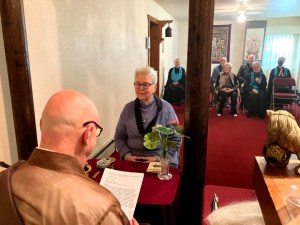
Janelle Reinelt, a Priory Sangha member who had moved to Seattle, came down to the Priory to take the Buddhist Precepts. We held the Precepts ceremony on March 14 with many of the temple Sangha members attending. Commitment is essential for spiritual progress and we are happy to help Janelle make a deep commitment to her Buddhist training.
With Gratitude
Charity is one of the four wisdoms and demonstrates the Bodhisattva’s aspiration. The generosity of the entire Priory Sangha is what makes it possible for the Priory to exist and for the Dharma to be freely offered to whomever is interested.
In recent months, we have been given many generous gifts, including a leaf rake, buddha statues, clothes, flowers, books, tools, plants and paper goods.
During the past few months we have been given food donations of pies, cakes, soups, salads, various vegetables and fruit, soy milk, coconut milk, tofu, breakfast cereal, vegetarian burgers, vegetarian meats, coffee, teas, nuts, various chips, peanut but- ter, eggs, and fruit preserves. You are always welcome to check with the Priory on what foods are currently needed.
Introductory Meditation Retreat
May 31 July 26 (10 am–5 pm)
This introductory meditation retreat will provide an intro- duction to the sitting meditation and the basic teachings of the Soto Zen tradition. It will include meditation instruc- tion, several period of meditation and a Dharma talks on how to practice meditation and integrate Buddhist teaching with our lives. A vegan lunch is included with the retreat.
Priory Meditation Retreats
April 12 May 17 June 14 July 12 (8 am–5 pm)
Retreats are an excellent way to deepen our meditation and training. The retreat is 8am to 5pm and the day is a mixture of meditation, Dharma talks, spiritual reading and Buddhist services.
Meditation Instruction
Meditation instruction and an orientation to the practice at the Priory are offered each Thursday at 6:45 pm. Please arrive a few minutes early so that we can begin promptly at 6:45. The instruction is followed by a 7:30-8:05 pm meditation period. We ask all people new to our practice to attend this instruction. The meditation instruction is free, as are all the activities at the Priory. If your schedule will not allow you to come on Thursday evening, you are welcome to call the Priory to try to arrange a different time for the instruction.
Priory Support and Membership
There are no fees for participating in meditation, Dharma talks, Bud- dhist services, retreats, spiritual counseling or any other services the Priory offers. We are supported by the donations of our congregation and friends. All gifts of any kind, whether money or materials or labor, are deeply appreciated.
 Berkeley Buddhist Priory
You must be logged in to post a comment.