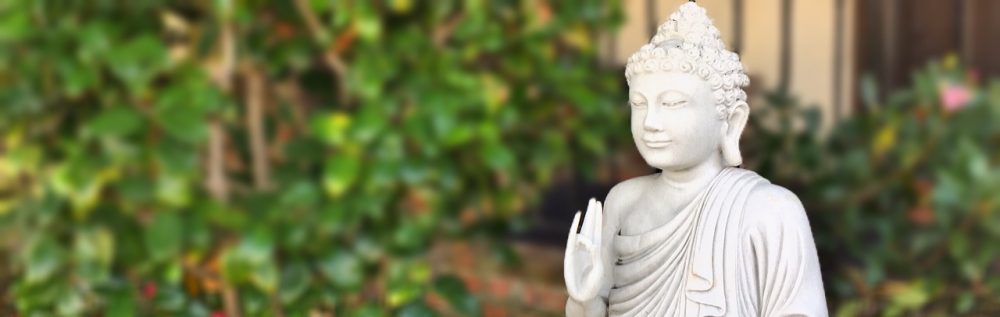

Still Flowing Water
by Rev. Kinrei Bassis
I will talk about the most famous image of Buddhist training, the Buddha meditating under the Bodhi tree on the night of his enlightenment. During that night, the Buddha described being attacked by the forces of Mara. In Buddhism, Mara represents all our unwholesome impulses. The Buddha experienced the feeling of being attacked by all his deepest fears and his fiercest desires. Instead of reacting to all these strong feelings, the Buddha did what is the essence of Buddhist meditation, he sat still. That meant that he did not react and allow himself to be moved by his strong feelings of fear and desire. The Buddha just allowed everything to arise and everything to pass away. The imagery used in Buddhism is that the swords and arrows that seemed to be threatening the Buddha were all transformed into the flowers of the Dharma.
To be a Buddhist means that we are trying to walk in the footsteps of the Buddha, and each of us needs to do, in our own way, what the Buddha did as he meditated under the Bodhi tree. This does not mean we need to sit under a tree but rather we all need to learn how to sit still and not be moved by the arising of powerful karma. This is the essential activity of Buddhist training, converting all our fears and desires, all our difficulties and pain, into the flowers of enlightenment; into the liberating life of the Buddha. This is the real meaning of meditation in daily life, sitting still and not getting caught up in our reaction to all the ups and downs of our life. In meditation, when a thought or feeling arises, the instructions are very simple. Try not to get caught up in your reaction. Just let it arise and let it pass. In daily life, we are trying to do the same thing. Whatever we encounter, we are trying to be still and recognize everything is just arising and passing away. We cleanse and free our hearts by just doing what the Buddha did under the Bodhi tree, which is to open our heart to whatever we are experiencing; to allow ourselves to feel whatever arises in our hearts, to be willing to see whatever thoughts are moving through our minds, and to allow everything to appear and then disappear. Not being caught up in all life’s ups and downs goes against much of our human conditioning. To sit still with our karma is very difficult and it requires deep faith. The Dharma keeps pointing us to this deep truth, that no matter what happens to us and no matter what happens in the world, nothing is fundamentally being gained or lost.
The Buddha taught that all suffering comes from facing the wrong way. Suffering means we are either clinging to what we are experiencing with desire or pushing away what we are experiencing with aversion and fear. Desire and fear just mean we are facing the wrong way and not looking for our real Treasure which can only be found within the stillness of an open heart and mind. The real core of the spiritual life is to open our hearts and minds so we let everything just flow through us. Suffering comes from not letting something just flow through us and thinking that we can’t let it go or we can’t put up with something. Our fears and desires cloud our perception of the world and drives us to close our hearts to many aspects of our life and to close our hearts to many of the difficult feelings that are within us. Fear, despair, confusion, greed and anger, they all can cause us to narrow our focus and close our hearts and minds. In life, we all experience being overwhelmed by strong desires or fears. When this happens, we narrow our vision and then cannot see beyond the confines of the situation. We lose touch with the open mind that allows us to see beyond the opposites. Buddhist training is learning to trust that there’s nothing that we fundamentally need and nothing that can truly hurt or damage us. When we are dealing with difficult karma, we need to be mindful and offer ourselves the appropriate Dharma teaching. It is not uncommon for people to encounter something that they will tell me they never thought they could put up with and to their great surprise, when it happened, it proved not to be so overwhelming or dreadful. I think everybody has experienced this, having what you deeply fear happen and then realizing that you did put up with it, you did learn something, and it did prove not to be a fundamental problem in a deeper sense.
We all would like to attain full liberation as the Buddha did under the Bodhi tree. But the path of Buddhist training is to take each bit of difficult karma, each fear, each desire, each difficult feeling, each painful memory, and do the hard work of liberating each piece of our karma. We liberate each piece of our karma as the Buddha did under the Bodhi tree, by letting all the karma flow through us without clinging or aversion. We do this by realizing neither our suffering or happiness, our joy or our distress, is something we possess. It is something arising and then passing through us. One of the fundamental ways we delude ourselves is by making something, anything, our possession.
Suffering arises when we cling to our past or when we cling to our possible future. Both are like clinging to a dream and they are just flowing through our lives like the weather. Everyone, everywhere, is just in the midst of this flow of karma from birth to death. This is an obvious truth but notice how hard it is to take that truth into our heart and realize that we cannot cling to anything; that there is nothing solid anywhere. In Buddhism, this flow from birth to death is called samsara. People look at a young baby and think of all the wonderful possibilities but they do not extend their view so that they are also seeing the inevitable old age, disease and death that the baby will have to experience. Every person in the senior nursing facility, every grave in the cemetery was once a baby, full of possibilities. What the Buddha’s Enlightenment meant is that he found that which is Buddha, the Unborn that which does not arise and pass, that which is the true ground and heart of all existence.
One of my favorite lines of teaching is from Trust in the Heart by the third Zen Patriarch in China, Kanchi Sosan, “The Supreme Way is not difficult if only you do not pick and choose.”「1」 Suffering is very simple. I suffer whenever I fight and resist whatever is flowing through my life. I want this and I do not want that. Living in the Bay area, I use traffic as a symbol of how we fight rather than accept our karmic conditions. It is normal for people to find it difficult when they are stuck in traffic and hardly moving. Yet, when you let go of the desire to be somewhere else, you are actually in reasonable comfort in a car that is not moving. Where is this suffering coming from?
I have been around people who have an incapacitating illness and are in considerable physical pain, yet, sometimes, despite their very difficult conditions, they are doing amazingly well, full of peace and joy. This indicates that they have found that spiritual place that frees them to know that they do not possess their pain and they are not being bound by these difficult conditions. Yet, the world is full of people who are doing very poorly, full of suffering, when nothing is really going wrong with their life. People often find emptiness in their lives, a seeming lack of the positive feelings they desire; a lack of love, of intimacy, of self-worth. This seeming emptiness in our life is not a real emptiness. It just means we have been looking in the wrong direction. Buddhism points us to how we can find a deep meaning and purpose in whatever we encounter. Everything we deal with in our life can be embraced with positivity as our next step in our journey to Buddhahood.
Right view in Buddhism includes realizing we are not in the driver’s seat. We have very limited control over what’s going to happen to us. I like the image of my life as a dwelling place with an endless flow of uninvited guests like worry, anxiety, fear and greed. I never wake up in the morning telling myself, today, I want to be filled with worry or anxiety, but if I look at my life, these uninvited guests such as worry and anxiety keep arriving and how I deal with this unwanted karma goes to the heart of Buddhist training. I need to be willing to be a welcoming host to whatever shows up in my life. Naturally, I would like to have a life in which everyone likes me, but what do I do with the uninvited guest of someone who dislikes me. I want the highway to allow me to drive unimpeded and let me effortlessly drive across the Bay Bridge but what do I do with the unwanted karma of being stuck in traffic. When someone tells me they don’t have trouble letting go of stuff that they have been lugging around for their whole life, it usually means that they have not even begun to understand what actual spiritual letting go involves.
To let go of our desires and fears means we first have the insight into how much stuff we are lugging around. Usually whenever someone first recognizes the enormity of their own personal karmic load, they find it overwhelming. The image often used in Buddhism is a mountain of karma. If you just look at many people, their faces are often etched with all the worries and fears that they are weighed down with. Unfortunately, most people cannot see themselves with Right View; they have no idea that there is an alternative to being weighed down with this heavy load. It is why we need to have compassion for all the suffering in the world since people do not know that they can let go of this load. And we all need to have compassion for ourselves, since there are very good reasons why we have such difficulty in letting things go. Letting go of what we are grasping in our life, is an awe inspiring task and if we are really willing to do it, we need the Dharma to go deeply into our heart. We need to fully feel the right and wrong of our thoughts and actions with our whole being. We can have a deep intellectual understanding with our brains of what needs to be done but for true transformation, the teaching needs to penetrate our hearts in order for us to wholeheartedly change how we relate to everything in our life. I remember a fellow monk telling me about how he gave one of his first Dharma talks on anger. The talk went very well, with many people telling him how helpful his talk was on dealing with anger. He felt wonderful as he walked away and then he saw somebody doing something that was not what he had asked them to do, and he lost his temper. Everyone who has attended a Dharma talk has had the experience of hearing something that deeply made sense but then had no real impact on how they related to normal situations in their daily life.
The Thai Buddhist Master, Ajahn Chah, gave the following teaching:
Have you ever seen flowing water?… Have you ever seen still water?… If your mind is peaceful, it will be just like still, flowing water. Have you ever seen still, flowing water? There! You’ve only ever seen flowing water and still water, haven’t you? But you’ve never seen still, flowing water. Right there, right where your thinking cannot take you, even though it’s peaceful, you can develop wisdom. Your mind will be like flowing water, and yet it’s still. It’s almost as if it were still, and yet it’s flowing. So I call it “still, flowing water.” Wisdom can arise here.「2」
The Buddha as he meditated under the Bodhi tree, let all of his thoughts and feelings flow through him, just like water flowing. Yet he sat still, just like still water. The difficult task of Buddhist training is life will always keep flowing. Good and bad, pleasure and pain, success and failure, birth and death, will keep flowing through us. We cannot ignore this flow as it is necessary and spiritually essential for us to try to help all this karma flowing through us so that everything can have as good an outcome as is possible. Yet we can be inwardly still and realize we do not have to be moved with this flow of karma. We can sit still as the Buddha did. Yet we are also part of this flow of karma and we need to do what actions will bring forth good so that we help all these karmic conditions and offer whatever help we can to all sentient beings. This is the purpose of Buddhism: to free ourselves so we are at peace no matter what karmic conditions are flowing through our lives but still being willing to make the right choices so that our lives are benefiting all sentient beings including ourselves.
「1」 Faith in the Mind by Seng Ts’an, The Poetry of Enlightenment by Chan Master Sheng-Yen (Shambala 2006) p.25
「2」 Ajahn Chah: Food for the Heart (Wisdom Publications 2002) p.370-371
Who’s Driving?
by Vicki Teishin Houdyshell
(Reprinted from the Berkeley Priory Newsletter March 1978: This article was written by Vicki Houdyshell in 1978 when I knew her as a fellow layperson at the Priory. She later was ordained at Shasta Abbey as a monk and given the name, Teishin. Teishin was a monk at the Abbey for a number of years and then returned to lay life where she remained an active Sangha member. She died very unexpectedly in February from complications from knee surgery. Note by Rev. Kinrei)
Since I have been driving, I have been in two car accidents in which I was behind the wheel. In both accidents, at the moment that I woke up to the fact that I was in an automobile which was about to crash, I was introduced to a very excellent driver within myself who has been there all along, but of whom I had not been aware. This driver then proceeded to carefully and calmly do everything that needed to be done and could be done to minimize the damage without worry, without fear and without a second thought. All of this took place in the space of a few seconds and after that the driver disappeared.
I have asked myself what is the difference between this driver and the ordinary driver who drives my car most of the time. One difference is that the excellent driver has accepted the fact that the car is going to crash. There is no worrying about how to do the impossible and make the accident not happen, no wondering what it all means or what the result will be, no covering the eyes and pretending that the object in the road ahead is not there. The excellent driver simply deals with the situation as it is; not as it should be or as I would like it to be, but as it is.
I know that this driver is the Eternal Buddha. There are few times in my life when I let go and trust that the Buddha can, will and does drive my car, talk to a friend, cook a meal or write an article in the best way that it can be done. Few are the times when I really know that there is nothing I need to worry about, nothing to add, nothing to prove, nothing to do but what needs to be done.
I trust in the Eternal Buddha when I am in the middle of an automobile accident, but what is the difference between that instant before the collision and this moment as I sit writing? I think it is only the circumstance that is different. Nothing different is needed now than was needed then; I am no less able now than I was then, and somehow the situation is no less urgent now than it was then. So why don’t I trust in the Eternal Buddha all the time? FEAR. But fear is a funny thing. I am really afraid of car wrecks. I worry about them often, but the one time when I am absolutely without fear of car wrecks is when I am in one. And so it seems that if I could live my life as if I were in one continual car wreck I would live without fear. But what does it mean to live as if I were in a continual car wreck? It means to accept the situation as it is in this instant, to remain absolutely still within, and to leave the driving to the Eternal Buddha.
And now I can hear myself saying, “I can’t do that. I don’t know how.” But, my own experience shows me that this voice is false. In the midst of the chaos of a car wreck I am absolutely still within. From this experience I know that it is possible, and that it is possible for me.
When I consider the difference between that moment before the crash and this moment, there is also something more. When I am in a crashing car I am very much aware that what is at stake is a life — my life — and the lives of others. But, in a way that I don’t really understand, there is no less life at stake in other moments of my life…. Each time I move away from stillness life is lost. Each time I turn away out of fear something dies…. What dies? I die! This must be what it means to kill. In order to keep the Precept perfectly that says “do not kill”, I must be still.
Each time I break the stillness, in a way, I kill myself. And somehow when I die everything dies. If I am with someone and I become afraid, and I turn away from them in my heart, even without saying anything, in that moment I hurt myself and the other person, because we do not live independently of each other. Life is the connection between me and those around me. When the connection is broken there is no life. If I am to keep the Precept which says “do not kill,” I must remain connected… To remain connected I must be open and not turn away.
To keep from turning away I must be still. But I am often not still — when fear comes up I frequently turn away, even though I know what is at stake. I have nothing to do, then, but to train harder, to sit still and trust in the Eternal Buddha who is always still whether or not I am afraid.
Priory News
by Rev. Kinrei
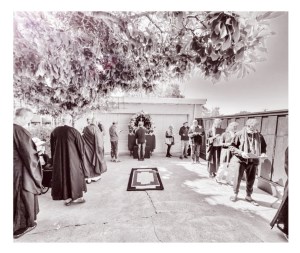
The Priory held its yearly Wesak celebration on May 26. Wesak is the most special day on the Buddhist calendar and it commemorates the birth of the Buddha. The Priory held the ceremony outside with altar covered with flowers. A large number of the Priory Sangha attended and ladled water over the head of the traditional baby Buddha statue. Water is often the symbol in Buddhism of compassion. The ceremony was followed by a Dharma talk and then there was a potluck lunch in the Priory garden.
Rev. Lambert who has been a monk for twenty-four years at the English monastery, Throssel Hole Abbey, came and stayed at the Priory for three weeks in June. Rev. Lambert had generously offered to take care of the temple so that I, as Prior, can be away for a few weeks. The Priory Sangha was very appreciative of Rev. Lambert’s kind presence and for his wise Dharma teachings. I am personally grateful for the help he was offering me. I spent a week at Shasta Abbey and a week at Shasta Abbey’s retreat house, the Compassionate Friend Hermitage. I am grateful for having some time in this very quiet and beautiful rural area and also deeply appreciated my time with my fellow Buddhist monks at the Abbey.
One of our earliest Sangha members, Lenny Pollack, who had attended retreats with Rev. Master Jiyu before there was a Berkeley Buddhist Priory, died on February 10. I went down to his home in Saratoga and assisted in a memorial for Lenny on April 5. It was well attended by his family and many his friends and it was moving to hear people give their memories of Lenny’s life. He had a positive influence on many people. On the front altar of the Priory is a beautiful Amitabha Buddha statue that Lenny had given to us when he was aware that his life was drawing to an end.
We held several animal funerals during the past few months. Nancy and Peter Townsend’s dog, Fergus, had a funeral on February 10. Kate Mehler and Chris Weber’s dog, Skipper had his funeral on June 16. It is good that we can make this offering of our merit and the Dharma to our deceased animals.
With Gratitude
Charity is one of the four wisdoms and demonstrates the Bodhisattva’s aspiration. The generosity of the entire Priory Sangha is what makes it possible for the Priory to exist and for the Dharma to be freely offered to whomever is interested. of the entire Priory Sangha is what makes it possible for the Priory to exist and for the Dharma to be freely offered to whomever is interested.
In recent months, we have been given many generous gifts, including flowers, books, plants and toilet paper.
Providing monks with food is the traditional offering given when coming to a Buddhist temple, and we appreciate all the generous food offerings we have been given. During the past few months we have been given food donations of bread, pies, soups, various vegetables and fruit, soy milk, coconut milk, tofu, peanut butter, breakfast cereal, vegetarian burgers, vegetarian meats, coffee, teas, moochi, nuts, various chips and fruit preserves. You are always welcome to check with the Priory on what foods are currently needed.
Introductory Meditation Retreat – July 27 (10 am–5 pm)
This introductory meditation retreat will provide an introduction to the sitting meditation and the basic teachings of the Soto Zen tradition. It will include meditation instruction, several period of meditation and a Dharma talks on how to practice meditation and integrate Buddhist teaching with our lives. A vegan lunch is included with the retreat. the basic teachings of the Soto Zen tradition. It will include meditation instruction, several period of meditation and a Dharma talk on how to practice meditation and integrate Buddhist teaching with our lives. A vegan lunch is included with the retreat.
Priory Meditation Retreats
July 13 August 17 September 14 October 12
Retreats are an excellent way to deepen our meditation and training. The retreat is 8am to 5pm and the day is a mixture of meditation, Dharma talks, spiritual reading and Buddhist services.
Shasta Abbey Retreats
Attending a retreat at Shasta Abbey is an excellent way to deepen one’s Buddhist life by living and practicing together with a large community of monastic and lay members of the Sangha. The introductory retreats are the recommended first step in practicing at the Abbey. For more information, you can go to their website at http://www.shastaabbey.org or contact the Guestmaster at (530) 926-4208 or guestmaster@shastaabbey.org.
Introductory Retreat July 12–14 August 9–11 September 6–8
Spiritual Counseling
Rev. Kinrei is available to discuss your spiritual practice and to help you to better apply the Dharma to your life. Taking refuge in a senior member of the Sangha is an important aid in gaining a better perspective and deeper insight into our spiritual life. It is also helpful in learning to cultivate openness and trust. You are welcome to contact the Priory and arrange a time to meet.
 Berkeley Buddhist Priory
You must be logged in to post a comment.